The Honest Draft: What Your Private Writing Reveals About Your Hidden Reader

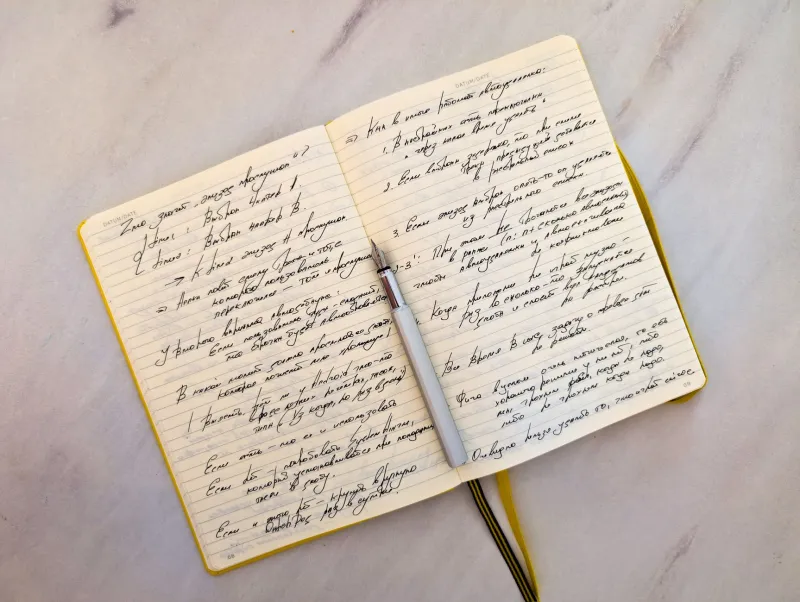
There is a particular kind of honesty that writers claim for their private pages. The journal tucked into a nightstand drawer. The document saved under a filename no one would recognize. The notebook carried to the coffee shop but never opened in anyone else's presence. We speak of these as the truest writing — unguarded, unperformed, and therefore most faithfully ourselves. But spend enough time scrutinizing what actually appears in those private spaces, and a more complicated picture emerges.
The writing we do when we believe no one is watching is not, in fact, free of an audience. It is merely free of a visible one.
The Ghost in the Margin
Consider the mechanics of word choice. A writer composing a personal journal entry about a difficult conversation at work will often select vocabulary that implies a reader who understands their professional context — abbreviations left unexplained, references to colleagues named only by first name, institutional shorthand treated as self-evident. This is not carelessness. It is, on closer inspection, an unconscious courtesy extended to a hypothetical reader who shares the writer's world.
Now ask: courtesy for whom? The writer is alone. The page has no audience. And yet the prose still accommodates one.
This phenomenon — what we might call the ghost reader — is not incidental to private writing. It is structurally embedded in it. Language itself is a social instrument, and the moment a writer arranges words into sentences, some version of a receiving mind has already been imagined. The question is never whether that imagined reader exists. The question is only how consciously the writer has acknowledged their presence.
The Shift That Happens When the Stakes Rise
Watch what changes when a writer transitions from private drafting to work intended for publication or public sharing. The vocabulary often elevates — not necessarily toward greater precision, but toward greater legibility. Sentence structures that felt complete in isolation are suddenly padded with clarifying clauses. Emotional directness, which read as honest in the private draft, gets softened into implication. Idiosyncratic phrasings — the ones that felt most genuinely theirs — get quietly smoothed into something more broadly palatable.
None of this is dishonest, exactly. But it is revealing. What it reveals is that the writer's private voice was never entirely their own to begin with. It was already shaped by assumptions about what a reader could tolerate, what a reader would recognize, and what a reader would find credible. The public draft doesn't introduce an audience. It simply makes the existing imagined audience more specific — and therefore more demanding.
The craft question this raises is not trivial: if the private draft and the public draft are both written for a reader, what exactly is the difference between them? The answer, it turns out, has less to do with authenticity and more to do with which reader the writer has chosen to serve.
Vocabulary as a Loyalty Test
One of the clearest diagnostic tools for identifying a writer's hidden assumptions is their private vocabulary. The words a writer uses when no one is watching tend to cluster around the communities that formed them — regional idioms, professional jargon, cultural references that feel universal from inside a particular social context but are, in fact, quite specific.
A writer who grew up in the American Midwest and now lives in New York may find that their private prose still carries syntactic rhythms and colloquial expressions from their earlier life — patterns that feel natural and unforced in solitude but that they consciously translate when writing for a broader audience. Neither version is more authentic. Both are accurate to different aspects of the same person. But the gap between them is instructive, because it maps the distance between the writer's private self-conception and their public self-presentation.
This gap is where a great deal of craft work actually lives, though it rarely gets discussed in those terms. Most writing instruction focuses on what to do with a draft once it exists. Far less attention is paid to the assumptions that shaped the draft before the writer was aware they were making choices at all.
Structural Choices as Social Signals
Beyond vocabulary, the structural decisions writers make in private drafts carry their own social logic. The writer who fragments their private entries into disconnected bursts of observation may be enacting a private rhythm that feels true to the way they actually think. But that fragmentation is also a structural argument — an implicit claim that coherence is overrated, that meaning can be gestured at rather than assembled. That argument is directed at someone, even if that someone is only a future version of the writer themselves.
Similarly, the writer who organizes even their most personal notes into numbered lists or clearly delineated sections is not simply being tidy. They are applying a framework that presupposes a reader who needs orientation, who values clarity over immersion, who might be confused without a map. That presupposition is a social act, performed in private.
None of this is to suggest that writers are being dishonest with themselves. It is to suggest that the self doing the writing is always already in conversation with something outside itself — and that pretending otherwise produces a particular kind of blindness.
The Case for Conscious Intentionality
If the private draft is never truly private, the response is not to mourn the loss of some impossible purity. The more productive response is to take the ghost reader seriously — to name them, examine them, and decide whether they deserve the influence they've been quietly granted.
This is what genuine intentionality in writing actually requires. It is not the discipline of writing the same way regardless of who is watching. That standard, however appealing in theory, ignores the reality that context is meaning, and that the same words assembled for different readers are, in a meaningful sense, different sentences. The discipline is something more demanding: it is the practice of knowing which reader you are writing for in any given moment, and making that choice deliberately rather than inheriting it by default.
The writer who examines their private drafts not for what they reveal about their authentic self, but for what they reveal about their unexamined assumptions, is doing some of the most honest craft work available. They are reading their own margins — and finding, written there in a hand they almost recognize, the outline of a reader they never consciously invited.
That reader has been there all along. The only question is whether the writer has been paying attention.