The Sacred Mess: Why Your Unpublished Scraps Contain More Truth Than Anything You've Polished
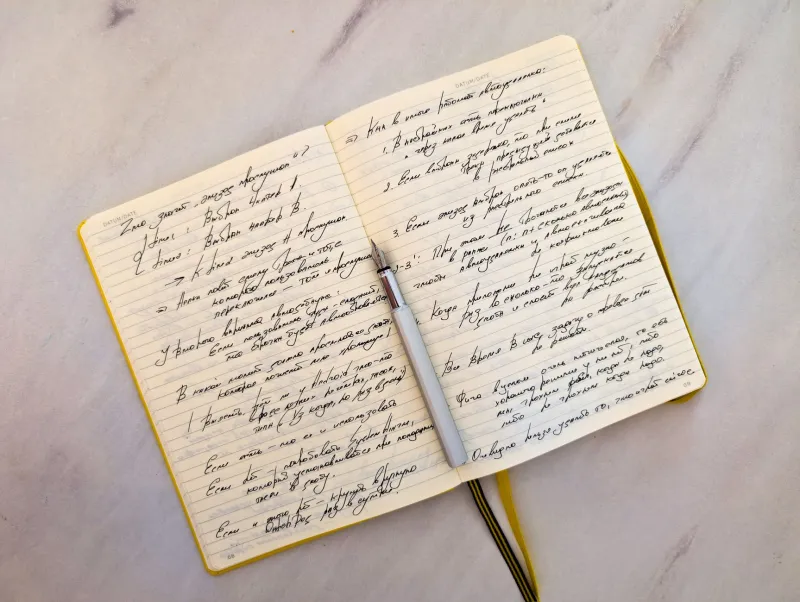
There is a particular kind of writing that happens in the margins — not the margins of a published book, though those carry their own strange intimacy, but the margins of a writer's life. The half-sentence jotted on the back of a receipt. The paragraph begun at midnight and abandoned before the second cup of coffee. The notebook that has never been photographed for Instagram, never quoted in a newsletter, never repurposed into a thread. These fragments exist in a state of radical freedom, answerable to no audience, beholden to no editorial logic. And it is precisely because of this freedom that they so often contain the most genuinely original work a writer will ever produce.
This is not a comfortable observation for a culture that has trained writers to regard every thought as potential content.
The Pressure to Perform Productivity
The contemporary writing landscape in the United States has developed a curious pathology: the compulsion to demonstrate the writing life rather than simply live it. Platforms reward visibility. Newsletters monetize process. Workshop culture elevates the shareable draft over the private experiment. The result is a creative economy in which the journey from raw thought to published artifact has been compressed to the point of near-simultaneity. Writers post their ideas before those ideas have had time to breathe, calcify, or reveal their actual shape.
What is lost in this compression is something essential. The margin — the private, unshared, unmonetized space of creative thought — has historically functioned as a laboratory rather than a waiting room. It is where a writer discovers what she actually thinks, as opposed to what she has decided to think for the benefit of an audience. The difference between those two states is the difference between voice and performance.
When every scrap is auditioned for publication, the scrap changes. It becomes self-conscious. It begins to arrange itself for legibility, to smooth its own roughness, to anticipate objections. This is useful behavior in a finished piece of work. In the earliest stages of genuine creative thought, it is quietly devastating.
What Marginalia Actually Is
The word marginalia carries a pleasant academic weight, conjuring images of medieval monks annotating scripture or John Adams arguing with his books in the margins. But the concept extends far beyond literal annotations. Marginalia, in the broadest sense, is any writing that exists outside the frame of intended publication — the notebook that never becomes a manuscript, the draft that is abandoned not out of failure but out of instinct, the observation recorded for no reason other than that it demanded to be recorded.
This category of writing has a distinctive texture. It tends to be faster, stranger, and less tidy than work produced with an audience in mind. It follows associative logic rather than argumentative logic. It is willing to be wrong, to contradict itself, to circle the same idea from three incompatible directions without resolving the tension. These qualities are not defects. They are the signatures of a mind genuinely at work rather than a mind performing work for observation.
Some of the most celebrated writers in the American literary tradition kept voluminous private notebooks that bore little resemblance to their published prose. Joan Didion's notebooks, which she wrote about with characteristic precision in Slouching Towards Bethlehem, were not drafts. They were not research. They were, she argued, a method of keeping track of the person she was — a record of a sensibility rather than a record of ideas. The distinction matters enormously. A sensibility cannot be monetized. It can only be inhabited.
The Notebook as Laboratory, Not Inventory
The problem with treating private writing as a holding pen for future content is that it corrupts the nature of the space. Once a writer begins to regard her notebook as a reservoir from which publishable material will eventually be drawn, she begins — often unconsciously — to write for extraction rather than exploration. The entries become more structured. The observations become more aphoristic. The mess, which is the point, begins to clean itself up in anticipation of an audience that hasn't arrived yet.
This is a subtle but significant betrayal of what the private page offers. A laboratory is not a pantry. Its value lies not in what it stores but in what it permits: failure, repetition, contamination, surprise. The experiment that goes nowhere is not wasted. It is, in many cases, the most important experiment conducted, because it eliminates a direction and clears space for something more true.
Writers who protect their notebooks from the logic of content production often report that those notebooks contain their best sentences — lines that never made it into finished work precisely because they were too strange, too personal, or too unresolved to survive the editorial process. This is worth sitting with. The editorial process, for all its necessity, operates as a filter that removes certain kinds of truth along with certain kinds of noise. The private page holds what the filter discards.
On the Radical Act of Not Sharing
In the current moment, choosing not to share a piece of writing is experienced by many writers as a form of failure — evidence that the work wasn't good enough, or that the writer lacks the entrepreneurial confidence to put herself forward. This interpretation deserves to be challenged directly.
Not sharing is, in fact, one of the more demanding creative disciplines available to a writer. It requires resisting the immediate validation that comes from posting, the dopamine architecture of likes and responses, the sense that writing has fulfilled its purpose only when it has found an audience. To write something and then place it in a drawer — or a private document, or a physical notebook that will likely never be read by another person — is to insist that the act of writing has intrinsic value independent of its reception. That insistence is increasingly countercultural.
It is also, arguably, the posture from which the most durable work eventually emerges. The writer who maintains a genuine private practice — who keeps a space where the work is not yet anything, where it is permitted to be confused and excessive and unresolved — tends to bring a different quality of material to her public writing. The private space does not merely generate content. It generates depth, the kind that readers sense even when they cannot name it.
Protecting the Margin
None of this is an argument against publication, against craft, or against the legitimate ambition to reach an audience. It is an argument for proportion. For the recognition that a writing life requires both a public dimension and a private one, and that the private dimension is not simply the backstage area where content is prepared for performance. It is a distinct and irreplaceable mode of creative existence.
The margins are not where you store your ideas until they are ready. They are where you discover what your ideas actually are. They are where your voice, unobserved and unauditioned, speaks in its native register. And they deserve the same ferocious protection that any serious writer extends to her most important work — because they are, in ways that may not be immediately legible, exactly that.