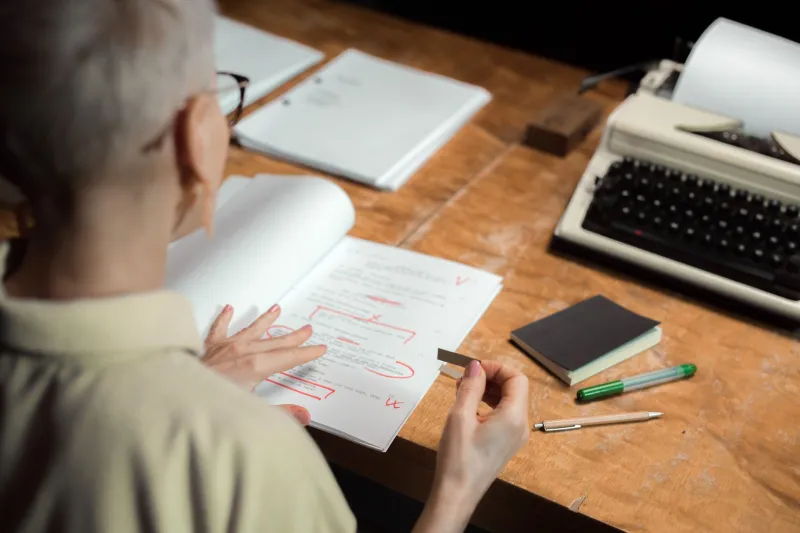
The Draft That Wouldn't Die: On Staying With Difficult Work

The Seduction of the New
There is a particular kind of relief that arrives when a writer opens a blank document. The cursor blinks without judgment. The page carries no memory of yesterday's failed paragraph, no residue of the chapter that refused to cohere. Starting over feels, in those first few minutes, almost indistinguishable from starting well.
This is the seduction of the new draft — and it is one of the more quietly destructive forces in a writer's creative life.
Across workshops, online writing communities, and the informal advice passed between writers at readings and residencies, a particular philosophy has taken hold: when a project stalls, the productive response is to move on. Begin something fresh. Trust momentum. The idea that suffering through a difficult manuscript builds anything of value is increasingly treated as a romantic relic, the kind of advice dispensed by writers who romanticize struggle rather than respect efficiency.
But efficiency, as a governing value for literary work, deserves scrutiny. And so does the assumption that the impulse to abandon a draft is usually a sound creative instinct rather than a well-dressed form of avoidance.
What Abandonment Actually Feels Like
Most writers who have left a manuscript unfinished will describe the decision in strategic terms. The project wasn't working. The voice felt wrong. The timing was off. The market had shifted. These explanations are not necessarily false — but they are often incomplete.
Beneath the strategic language, abandonment frequently carries a distinct emotional signature: the relief is too immediate, too total. When a writer sets down a genuinely dead project, there is often a kind of grief mixed into the release. When a writer sets down a project they were afraid to finish, the relief is cleaner. Purer. Almost euphoric.
That euphoria is worth examining.
Fear-based abandonment tends to cluster around specific creative thresholds. The middle of a manuscript — what screenwriters sometimes call the "muddy middle" — is a common departure point, because it is where the initial excitement of an idea has spent itself and the writer must confront whether the architecture beneath the surface is actually sound. Another common exit point arrives just before the work becomes personal in ways that feel uncomfortably exposing. A third appears when a writer begins to sense that finishing the project would require acquiring skills they do not yet possess.
None of these are reasons to abandon a manuscript. They are, in fact, reasons to stay.
The Difference Between Dead and Dormant
This is not an argument for finishing every draft at all costs. Some manuscripts genuinely are beyond reclamation — not because the writer failed, but because the project was conceived at the wrong angle, or because the writer's interests have evolved in directions the work cannot follow. Strategic abandonment is a legitimate creative act. Writers who have spent years trying to resurrect projects that no longer reflect their sensibilities understand this well.
The distinction worth drawing is between a project that has died and one that is merely dormant.
A dormant manuscript tends to exhibit certain recognizable qualities. It surfaces in the writer's mind uninvited. Unrelated experiences — a conversation overheard in a coffee shop, a passage in someone else's novel, a particular quality of late-afternoon light — keep generating thoughts about the abandoned work. The writer finds themselves mentally drafting scenes they have not yet written. There is, underneath the stated reasons for setting the project aside, an unresolved quality, a sense of something left unsettled.
A dead manuscript, by contrast, tends to recede. It becomes an artifact — something the writer can recall with clarity but without urgency. The emotional charge dissipates. The characters stop generating new questions.
Learning to read these signals accurately is one of the more undervalued skills a writer can develop.
The Ambition That Undermines Itself
There is an irony embedded in the culture of perpetual creative momentum. Writers who move rapidly from project to project often do so in the name of ambition — they want to produce more, grow faster, find the work that will break through. But the practice can quietly undermine the very ambition it claims to serve.
Ambition in writing is not merely about volume. It is about depth. And depth requires duration — the willingness to remain in the company of difficult material long enough for genuine understanding to develop. The writers whose work tends to carry lasting weight are rarely those who moved most quickly. They are, more often, those who stayed longest with the questions that troubled them most.
This is not a fashionable observation. It runs counter to the productivity frameworks that have colonized creative culture, the ones that celebrate output metrics and treat the finished draft as the primary unit of success. But the finished draft is not the goal. The developed writer is the goal. And development requires friction.
Abandoning a difficult manuscript before it has taught you what it has to teach is a way of avoiding exactly the friction that would have changed you.
A Framework for the Stalled Page
For writers navigating a manuscript that has lost momentum, a few practical distinctions may prove useful.
First, separate the diagnosis from the feeling. Before deciding a project is broken, ask whether the problem is structural — a genuine flaw in premise, character, or architecture — or whether the problem is emotional. Structural problems can often be solved. Emotional resistance usually cannot be outrun by starting a new project; it tends to reappear, wearing different clothes, in the next one.
Second, consider the nature of the stall. Is the work difficult because it is asking the writer to do something they do not know how to do yet? If so, the solution may be study, not abandonment. Reading widely in the genre or form that is causing difficulty, seeking out craft books that address the specific technical challenge, or even setting the manuscript aside for a defined period while developing relevant skills — these are all forms of staying with the work, even when not actively writing it.
Third, distinguish between the manuscript and the material. Sometimes the particular draft is genuinely beyond saving, but the underlying subject matter, the story, the question at the heart of the project, remains vital. In those cases, abandoning the draft is not abandoning the work. It is clearing space to approach the same essential territory from a stronger position.
The Page That Waits
There is a document on the hard drives of most serious writers — a file that has not been opened in months or years, a project that was set aside during a difficult stretch and never quite retrieved. Some of those files are genuinely finished with their writers. Others are waiting.
The discipline of distinguishing between the two is not a minor skill. It is, in many ways, central to what it means to develop as a writer over time — to move not just from project to project, but from one version of oneself to a more capable and honest one.
The blank page is always available. It will always offer its clean, uncommitted welcome. But the draft that has already accumulated weight, that already carries the partial shape of something real — that is rarer. And it may be worth more than the relief of walking away from it.