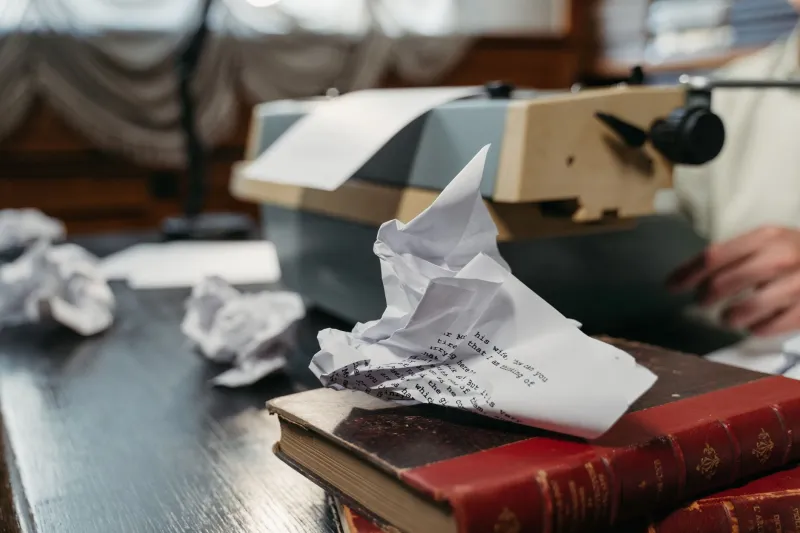
The Art of Strategic Stillness: In Defense of the Writer Who Isn't Writing

There is a particular guilt that visits writers during the quiet stretches — those afternoons when the document sits closed, the notebook remains on the shelf, and the hours pass without a single sentence committed to the page. American productivity culture has no vocabulary for this kind of pause that isn't tinged with shame. We speak of writer's block as a malfunction, of fallow periods as failures of discipline, and of rest as something a writer earns only after the work is done. But what if the work, in its most essential form, is sometimes the doing of nothing at all?
This is not a romantic apology for procrastination. Avoidance and idleness are not the same creature, though they wear similar faces. Avoidance is fear dressed in leisure. Strategic stillness, by contrast, is a conscious act of trust — trust that the mind, when released from the tyranny of output metrics, will continue its labor in the dark, assembling connections that the vigilant, striving consciousness would never allow to form.
The Subconscious as Collaborator
Cognitive science has long suggested that the brain does not simply pause when we step away from a demanding task. The default mode network — that constellation of brain regions active during rest, daydreaming, and mind-wandering — is now understood to play a significant role in creative synthesis. When a writer takes a long walk, stares out a train window, or sits on a porch doing nothing in particular, the narrative problems left unsolved at the desk do not vanish. They migrate. They slip beneath the surface and continue their rearrangement in a register the conscious mind cannot directly access or, crucially, interrupt.
Many writers have described the experience of solving a structural problem not at the desk but in the shower, on a run, or in the drowsy minutes before sleep. These are not coincidences or charming anecdotes. They are evidence of a process that the compulsion to always be producing actively suppresses. Every hour spent forcing words onto a page that isn't ready for them is an hour stolen from the subconscious work that would have made those words worth writing.
What We Mean When We Say 'Working'
The problem is partly definitional. Writers — and the culture that surrounds them — have adopted a dangerously narrow understanding of what it means to be working on a manuscript. Typing constitutes work. Outlining constitutes work. Revision, research, even staring at a blinking cursor constitutes work. But sitting in a park and letting the mind drift? Walking through a neighborhood with no notebook in hand? These do not register on the productivity ledger, and so they are quietly omitted from any honest account of how a piece of writing came to be.
This omission distorts the record. It creates a mythology of the writer as a creature of relentless application, which in turn generates unrealistic expectations — for emerging writers especially — about what a sustainable practice actually looks like. When the reality of their own process fails to match the mythology, many writers conclude that they are doing something wrong, rather than recognizing that the mythology itself is the problem.
The American Urgency Problem
The United States has a complicated relationship with rest. Vacation time goes unused. Busyness is worn as a badge of seriousness. The hustle narrative, which migrated from entrepreneurial culture into creative communities sometime in the last decade, has convinced a generation of writers that visibility and volume are proxies for artistic commitment. Post about your word count. Share your writing schedule. Document the grind.
None of this is inherently malicious, but its cumulative effect on the interior life of a writer is corrosive. The act of writing — genuinely literary writing, the kind that reaches for something beyond mere competence — requires a quality of attention that cannot be sustained by a person who is simultaneously performing their productivity for an audience. The writer who is always working, always generating, always demonstrating their dedication, is often the writer who has no quiet left in which the deeper instincts can speak.
Rest, in this context, is not a reward for completion. It is a condition of quality.
Building Emptiness Into the Practice
What does it look like, practically, to treat idleness as a legitimate component of a writing practice rather than an embarrassing gap in it?
It begins with permission — the simple, difficult act of deciding that time spent away from the manuscript is not time wasted. This is harder than it sounds. Permission must be renewed constantly against the ambient noise of a culture that equates stillness with stagnation. It requires a writer to trust their own process over the metrics that other people can see.
Beyond permission, it requires intention. There is a difference between collapsing in front of a screen after a long day and deliberately choosing to take an unhurried walk, to sit in a coffee shop without a laptop, to read something entirely unrelated to the project at hand. The latter is a form of creative maintenance — a way of keeping the instrument in tune without demanding that it perform.
Some writers find it useful to keep a loose, low-pressure journal during these intervals — not to force output but to catch whatever surfaces without effort. Others prefer complete separation from any writing-adjacent activity. The specific form matters less than the underlying disposition: an openness to what arrives when nothing is being demanded.
The Prose That Silence Makes Possible
There is a quality in certain writing — a density of implication, a rightness of rhythm, a sense that each word has been chosen not just from the available options but from some deeper reservoir of necessity — that cannot be manufactured through sheer industry. Readers feel it even when they cannot name it. It is the quality of prose that has been allowed to become itself, rather than forced into existence before it was ready.
This is what the silence between drafts makes possible. Not idleness for its own sake, but the particular kind of creative fermentation that only occurs when the writer steps back and allows the work to continue without them. The manuscript does not stop when the writer walks away. In the most important sense, it is only then that it truly begins.
The writer who learns to trust that process — who can close the document without guilt, who can spend an afternoon existing without producing, who can resist the cultural pressure to always be demonstrably at work — is not the writer who is falling behind. They are, more often than not, the writer who is quietly getting ahead.